
Sports and fashion have always influenced each other, for the better part of the last century at least.
Prominent Parisian tennis players, Jane Régny and Suzanne Lenglen, kicked off the buzz in the early 20th century, Bruce Lee introduced the tracksuit in the 70s and Michael Jordan popularized and commercialized the fashionable side of basketball sneakers in the 90s.
All of these sportswear courtiers set out intentionally with the plan, but the story goes a little differently for German trainer Otto Martin Pfister.
Stop any man or woman on the streets of Ghana, ask them “who” Otto Pfister is; more likely than not, you will get an answer to “what” Otto Pfister is. The story of how a man’s name became an improper noun, begins here.
When he arrived on the shores of Ghana in 1991, he was desperate for success on the pitch, without the faintest idea of the impact he would have off it.
He had already made a mark with his 5th job on the continent, leading Burkina Faso (then Upper Volta) to their first AFCON qualification in 1978.
But that accomplishment drops a bundle in comparison to the colossus that was the Black Stars job.
Heading into AFCON 1992, Pfister had a tremendous pool of world class talents to pick from. There was Africa’s best player, Abedi Pele on one side, and Bundesliga sharpshooter, Anthony Yeboah, on another.

Expectations were high and he was confident of delivering Ghana’s fifth AFCON title. The team made it to the final in Senegal, but ultimately came up short.
Gutted and crestfallen, he left his post few months later, leaving a lasting legacy behind, which curiously had absolutely nothing to do with football, but instead, everything to do with how he wore his trousers.
In the early 90s, a mode of dressing began in parallel worlds, for completely different reasons, but generated similar response from society.
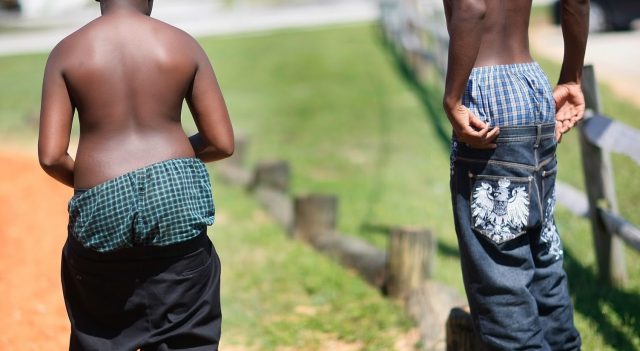
Sagging was slowly becoming a fashion norm among young black men in the United States of America, as well as in Ghana.
The most familiar origin of sagging in the former, is linked to the prison system. Inmates, prohibited from wearing belts, had no choice than to resort to sagging their prison-issued uniforms. They carried that look with them once they were released back into society.
This, together with the growing influence of hip hop, which at the time was slowly taking over the American music scene, popularized this bizarre form of fashion draping.
In Ghana, sagging had an unlikely inspiration – Otto Pfister.
Before he took over the Black Stars job, he had already led the Black Starlets to their first FIFA U-17 World Cup title in 1991. His popularity then skyrocketed, ironically, when he failed to win AFCON 1992.
Eccentric and outspoken, Pfister’s personality contributed to his charm. He was a media minefield, good or bad.