Once upon a time in the Republic of Uncommon Sense, going to church required only three things: a clean shirt, a willing heart, and coins that made noise in the offering bowl. Salvation was free, faith was communal, and the only “subscription” was your regular Sunday attendance—no password required.
Then something happened.
Somewhere between “Amen” and “Account Number,” heaven upgraded its user interface.
Today, you don’t just go to church—you log in.
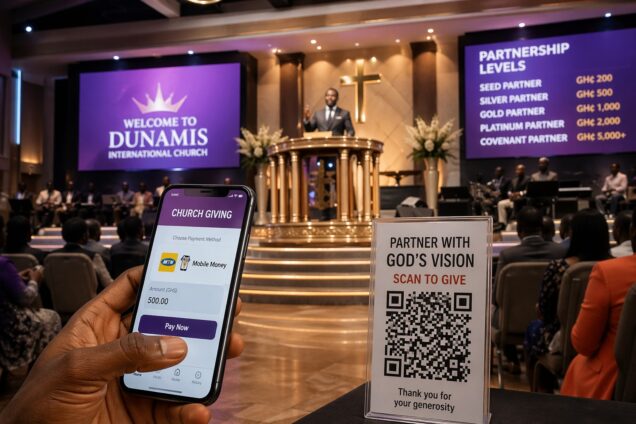
The altar now comes with Wi-Fi. The choir has a YouTube channel. And just when the Spirit begins to move powerfully, a gentle reminder appears on the screen: “Partners, kindly honor your pledge via MoMo.” Even angels, I suspect, now hover with QR codes.
My brother, my sister, faith has entered Version 2.0.
In the old days, the offering bowl walked humbly from pew to pew like a disciplined civil servant—no noise, no pressure, just quiet expectation. You gave what you could, and if you couldn’t, you smiled at the bowl and passed it on like a respected elder.
Today, the bowl has been promoted. It has become a digital executive.
Now it sends reminders. It tracks your consistency. It knows whether you are a faithful giver or a “God understands” contributor. Some churches have even mastered what I call “tiered anointing”—where your level of giving appears suspiciously aligned with your level of access.
Front row blessings for platinum partners. Balcony miracles for bronze members. The rest of us? Free trial.
Don’t misunderstand me—God has not changed. It is we, His earthly distributors, who have rebranded the packaging.
The modern church is no longer just a sanctuary; it is a full-service enterprise. There are products: anointed oil, blessed water, destiny books, prophetic consultations. There are services: breakthrough conferences, leadership summits, closed-door prayer sessions. There are even loyalty programs disguised as partnerships.
You don’t just belong—you subscribe.
Unlimited grace, billed monthly.
And then there is the pastor. Ah, the pastor of old—simple, solemn, slightly mysterious. Today’s pastor? A complete brand. A content creator. A CEO of spiritual enterprise. His sermons are not just messages; they are productions. His pulpit is not just a platform; it is a studio.
But before we rush to judgment, let us pause and look in the mirror—because the church, like the market woman at Kejetia, responds to demand.
In a country where jobs are uncertain, bills are relentless, and tomorrow is a rumour, people do not abandon faith. They invest in it.
Hope has become a form of currency. Prayer is emotional insurance. And when life becomes unpredictable, many are willing to pay a premium for reassurance.
So the church adapts. It organizes. It structures. It monetizes.
The question, however, is not whether the church should evolve. Every living thing must. The real question is: at what point does structure become commercialization? When does giving become pricing? When does faith quietly slip into the marketplace and begin to compete with airtime bundles and data subscriptions?
Because if we are not careful, one day we will arrive in church, ready to worship, only to be asked:
“Would you like Basic Salvation, Premium Breakthrough, or the Family Package?”
And we will nod, tap our phones, and say, “Please, add extra blessings to mine.”
Ah, the Republic of Uncommon Sense.
Where even heaven, it seems, is learning how to bill.
The writer, Jimmy Aglah is a Ghanaian media executive, satirist, and author of Republic of Uncommon Sense, where wit, irony, and common sense are deployed against the daily theatre of public life. He writes on politics, culture, faith, leadership, and the beautiful absurdities of modern society.